
Bow Fiddle Rock
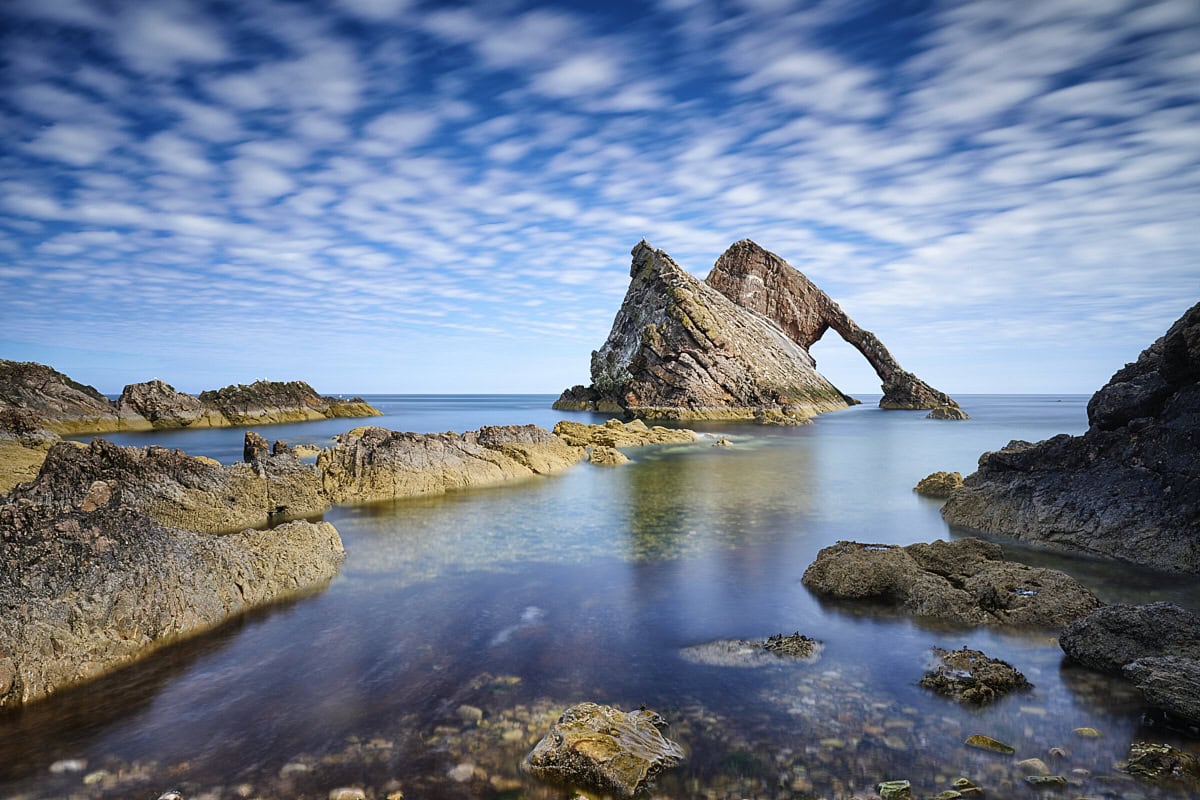
For the various countries and regions I photograph, I keep Google Maps into which I continuously enter places I want to visit one day. The very first entry on my Scotland map was Bow Fiddle Rock. The sea arch is named after its resemblance to a fiddle bow and sits at the edge of the village of Portknockie on the Moray Firth. Although I have now visited it several times, it continues to fascinate me – particularly for the photographic possibilities it offers.
Due to its location, Bow Fiddle Rock is an ideal subject for photography in the early morning hours. At high tide it is especially rewarding, because the arch is then completely surrounded by water. At low tide you can get closer to the rock, which opens up interesting possibilities of its own. Right next to the car park there is a viewpoint from which you can perfectly overlook Bow Fiddle Rock and the surrounding coastline. For photographing, however, it is better to walk the few metres down to the water’s edge. From that lower vantage point the rock feels considerably more imposing.
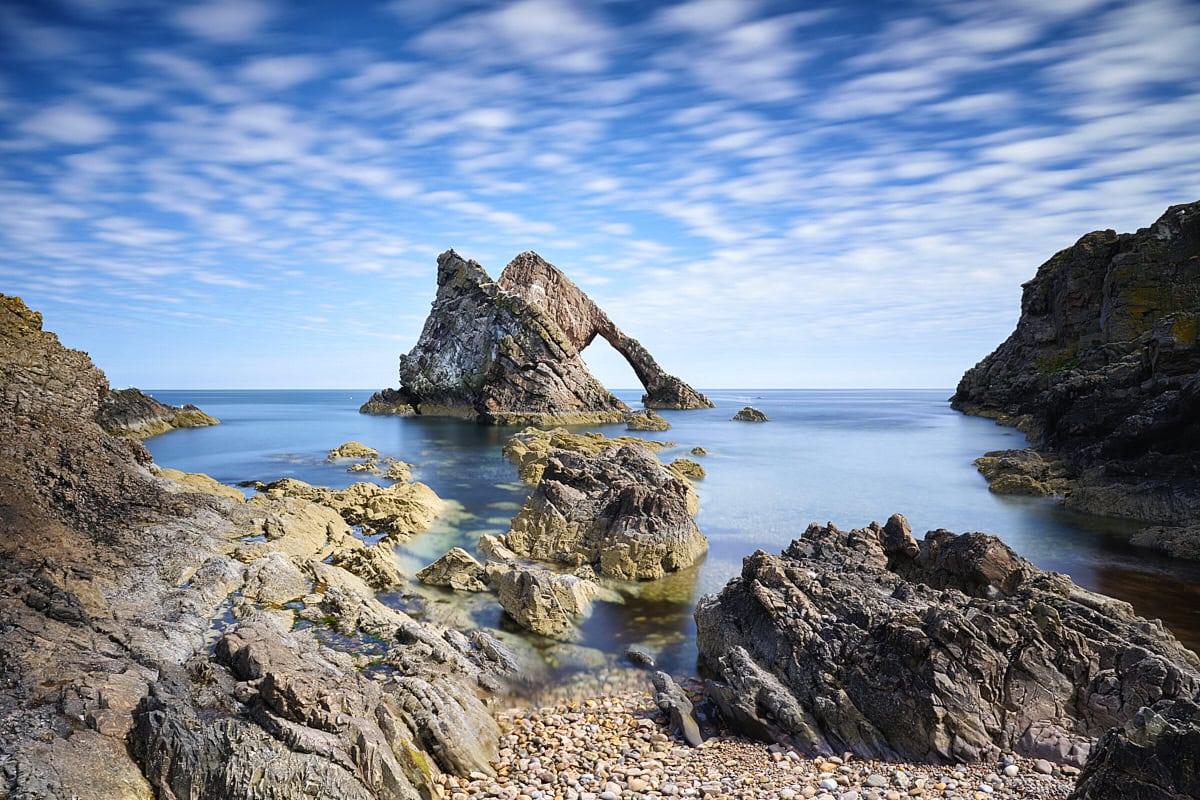
Bow Fiddle Rock is an ideal subject for long exposures. The surrounding water takes on a silky smoothness and can even reflect the rock. The rocks in the foreground can be incorporated excellently into the composition as leading lines. A classic subject in landscape photography.
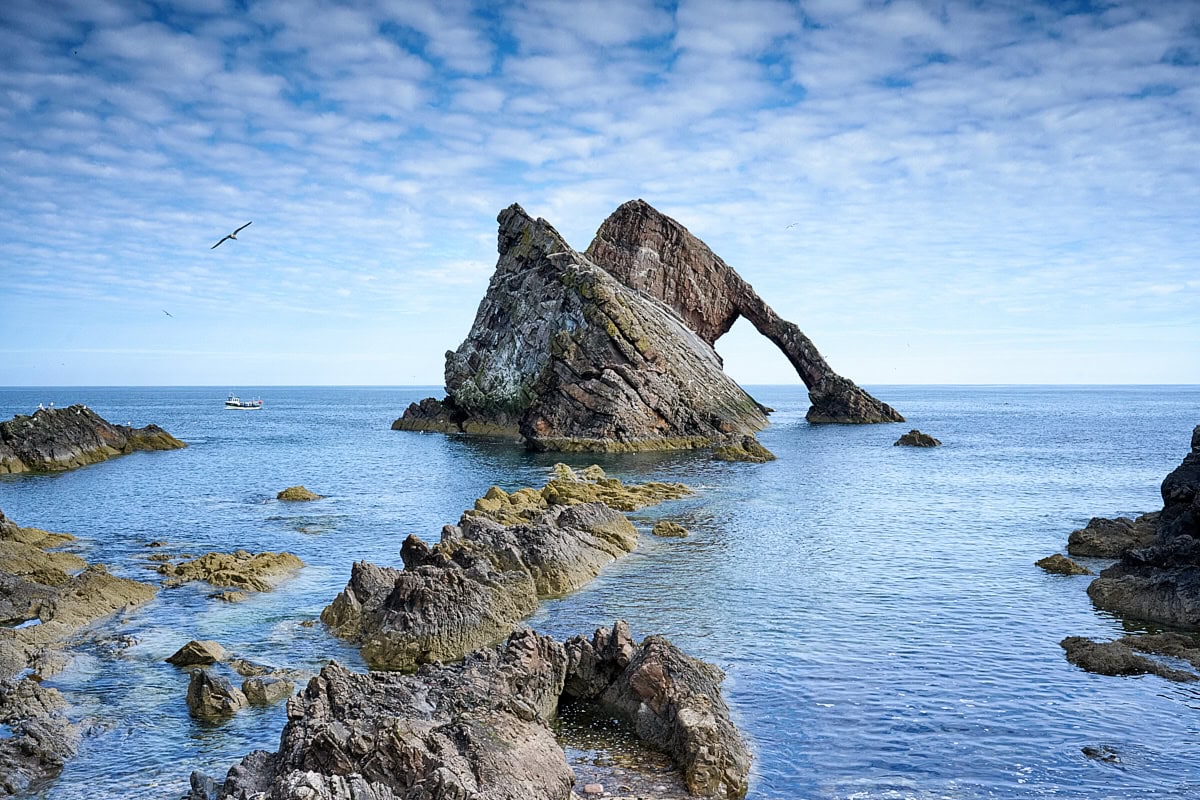
But the location is equally well suited to short exposures, as there is usually a great deal of movement around the rock. In the water, naturally, but also in the air, where seagulls circle constantly and briefly settle on the rock. Fishing boats sometimes pass behind it and can be incorporated effectively into the composition. It is worth trying both approaches on location. I am always struck by how differently this place looks depending on how you have photographed it.
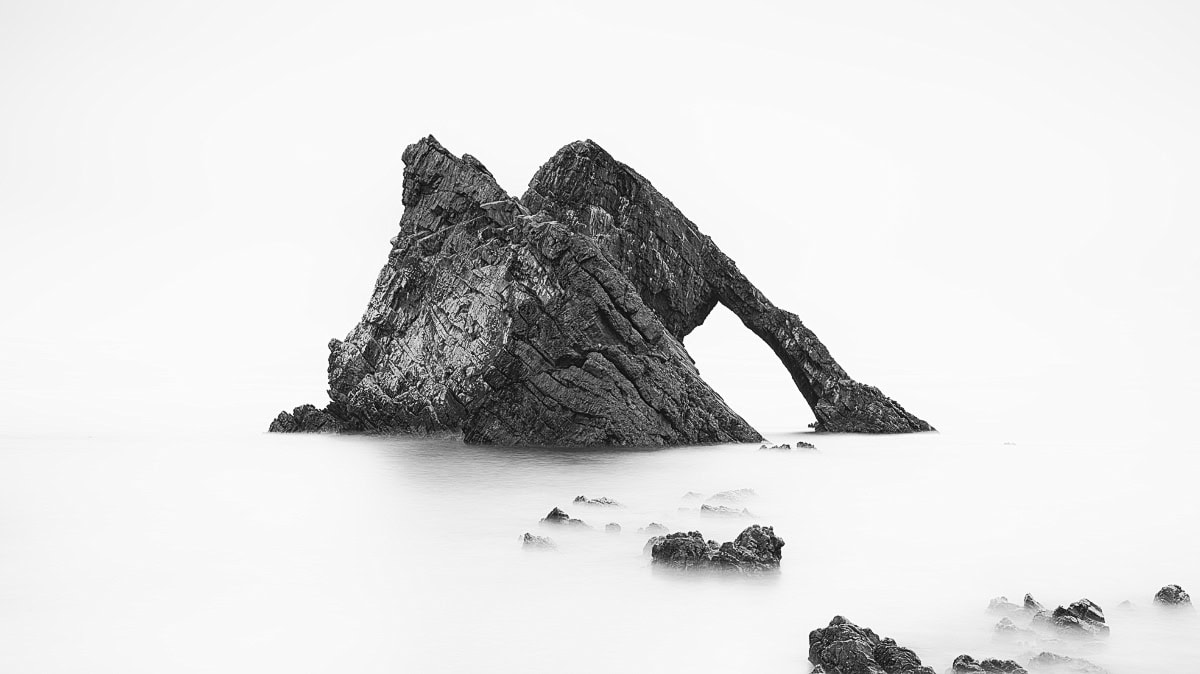
What makes this sea arch particularly special is its unusual shape. That is something you can really work with when photographing here on a grey day. And grey days are no rarity on the Scottish coast. On such days you can focus entirely on the rock itself – and that is precisely what makes this subject so compelling. In my example I converted the image to black and white and pushed the highlights until only the rock and a few stones in the foreground remained. That image captures the character of the rock best of all, even though the shooting conditions were the worst of all the shots shown here.
Location
Near Portknockie, Co. Moray, Scotland. (Maps)
Photography opportunities
Iconic rock arch off the coast.
Best time to photograph
Early morning at high tide.
Photo gear I used
Camera, 14–24 mm for panoramic shots and 24–70 mm for details, ND filter, tripod.
Photography tips
This is an ideal location to try out various seascape photography techniques. Take your time, you can really let your creativity run wild here.
The Portknockie Cliffs Path runs along the coast. There are further exciting cliffs to admire here.
Parking
Right on the outskirts of Portknockie. (Maps)
Walking Distance
It is about 70 metres from the car park to the viewpoint, and about 175 metres down to the pebble beach. The path down is a bit steep and uneven, but easily manageable.
Where to Stay Nearby
In Portknockie or Cullen.
Related posts
Hi I’m Stefan
On my blog, I take you along on my travels, write about photo locations, and share insights into my work as a landscape photographer.
Join my Newsletter
Subscribe to my free, monthly newsletter and get exclusive discounts, travel stories and insights about photo locations, and be first to hear about new releases and more:
By clicking on ‘Subscribe’, you agree that we may process your personal data in accordance with our privacy policy.
